

Soil: The Earth’s Dynamic Skin!
(Our most popular program)
What do a carrot, a brick, a glass, and Neosporin all have in common? They would not exist without soil!
Join us for this exciting, hands-on, interactive program on one of our most mysterious natural resources: the Soil! Learn the Soil’s secrets and stories.
Basic Information
- Programs are either two or four hours in length
- The four-hour program includes an extended outdoor field component
- Each program is inquiry-based, interactive, and has a fieldwork component.
- Maximum participant number: 50
- Ideal for school Gifted programs
- Workshops satisfy K-12 Earth, Life, and Physical Science NGSS
- See the Soil: Earth’s Dynamic Skin lesson plan
Find out how you can help protect one of our most vital natural resources.
See the Demo Video.
The Program:
- Learn the many connections between the soil and our lives.
- Find out How Much Soil Is There?
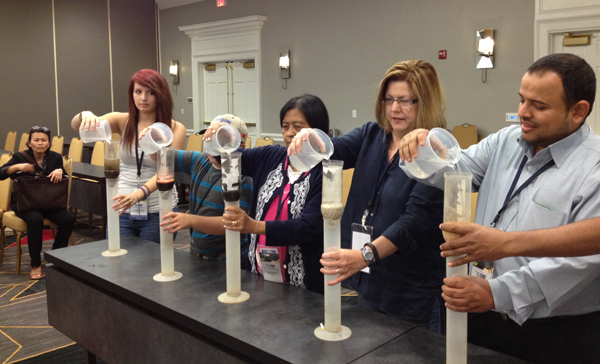
- Complete a fascinating learning activity on how soil filters water with “Just Passing Through” where students predict which soil will filter the fastest and cleanest water.
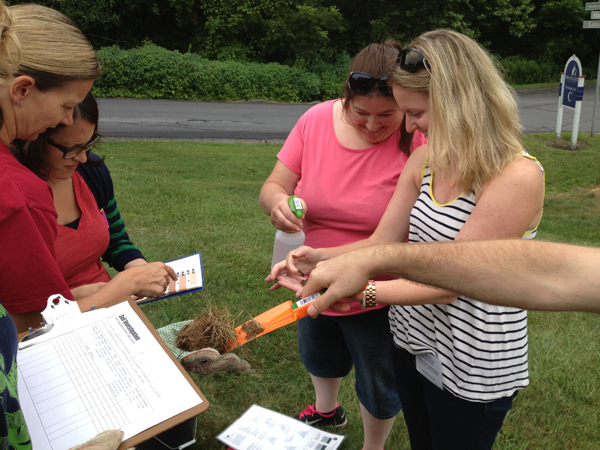
- See and feel the many colors and textures of the soil with hands-on learning activities in soil color, structure, and texture.
- Do soil science and analysis
- Have fun as you learn just how much soil there is in the world in this thrilling two-hour program.
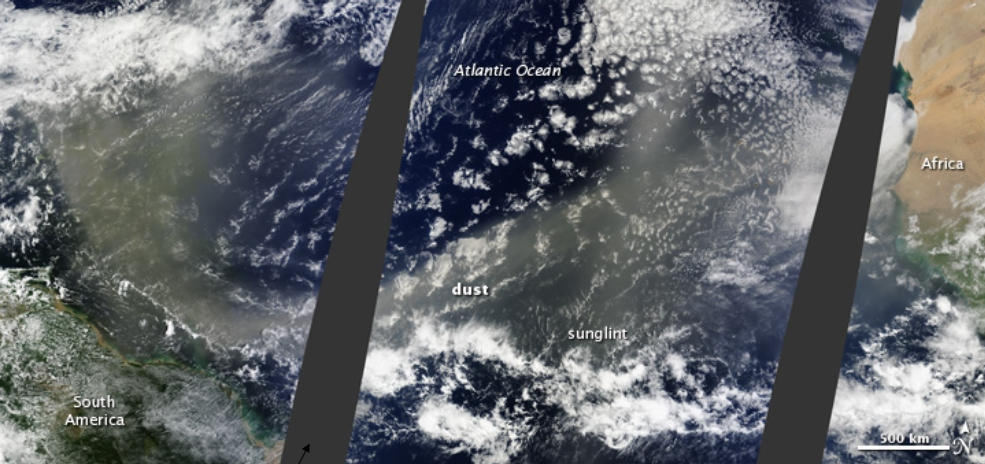
- See cool images like the one below from NASA, and learn how the soil impacts the entire planet.
Soil programs for K-12+ and beyond
These interactive programs are perfect for school events and assemblies as well as Girl or Boy Scout Training Days, and many other events.


What’s this soil’s story?
Every soil has one. Want to know this soil’s story? See below.

- This is an example of a soil profile. A soil profile is a series of soil layers below the soil surface that have certain properties because of how the soil was formed.
- The layers of a soil are called horizons. We can tell that horizons differ from each other by their color, texture, structure, consistence, thickness, and other properties.
- Because every soil forms differently, observing them closely can help us tell the story of what has happened at the location where the soil formed.
- If we look at the horizons in this soil profile, we can see something about the history of what happened here. We can see a few horizons at the top and then a dark layer labeled 3C3 in the middle. This soil is located at a dry stream bed. Each of the horizons above the 3C3 was deposited on top of it when the stream flooded over a period of many years.

- We know from dating techniques that the dark gray substance in Horizon 3C3 was deposited here approximately 150-250 years ago over a period of 100 years. What do you think it is?
- Answer: It’s ash from forest fires. Farmers used to set these fires because they practiced what is known as slash-and-burn agriculture. The results of some of that practice of burning down forests to make room for farms were deposited in this soil.
- Looking lower, we can see nodules or what look like rounded stones in the horizon labeled 4C4. These were deposited in this stream bed about 250-350 years ago. They are clam and oyster shells.
- The people who lived nearby would come to this area for their holiday feasts. They would bring clams, oysters, and fish with them. These shells were what they left behind.
- By observing the horizons in this one soil profile, we can tell the story of what happened in this spot over hundreds of years. Wouldn’t it be amazing to know the stories of other soils as well?
 Earth Lady Education